EUDR compliance · manufacturers & processors

Your factory's EUDR execution system.

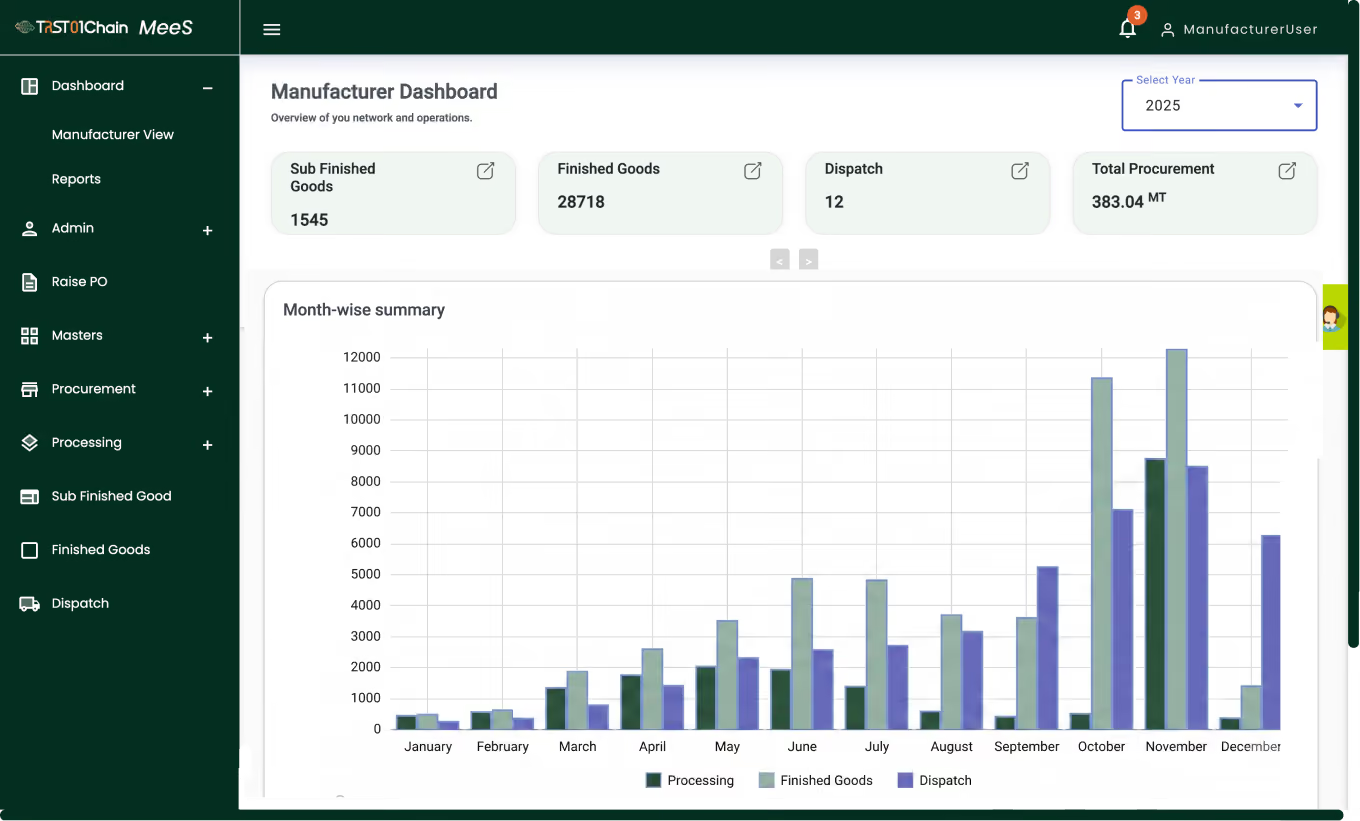
MeeS automates vendor compliance, deforestation checks and internal traceability, so every finished-goods shipment leaves submission-ready with Consolidated Polygon set and DDS.
TRST01 product hero graphic
Trusted by leading manufacturers
Integration-ready with your ERP
No double work, no re-keying
Check circle icon
SAP S/4HANA
Check circle icon
SAP ECC
Check circle icon
Oracle Fusion Cloud
Check circle icon
Oracle NetSuite
Check circle icon
Tally Prime
Check circle icon
and more, via API
Integration is optional, not required. Prefer to keep systems separate? Capture production data by FTP or Excel upload instead.
What EUDR asks of manufacturers
Turn your vendors’ EUDR data into finished-product compliance.
Your raw-material vendors supply the EUDR evidence, polygon, DDS and legality, for what they sell you. MeeS collects and verifies it, traces each input through your plant, and produces the EUDR documents for the finished product you supply onward, whether to a buyer or into the EU market.
TRST01 interface graphic
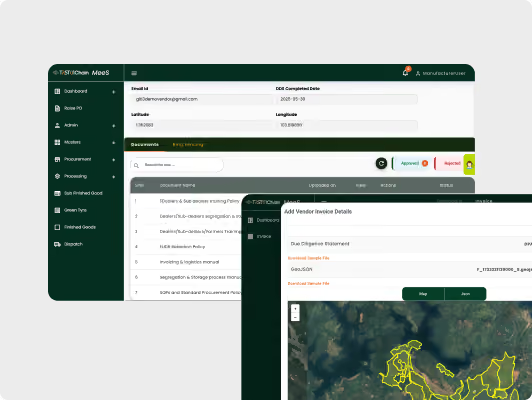
Vendor due diligence
Collect and verify polygons, DDS and legality evidence from every raw-material vendor.
TRST01 interface graphic
Internal traceability
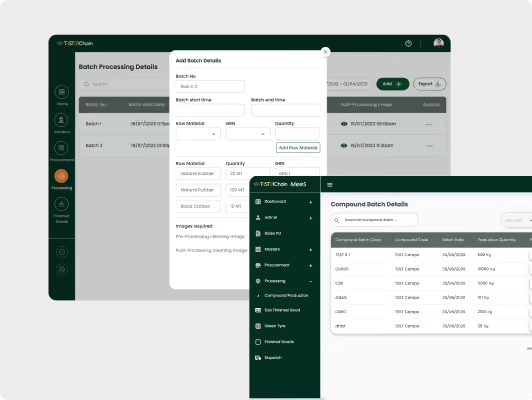
Link each finished-goods batch back to the raw-material GRNs and source plots.
TRST01 interface graphic
Consolidated GeoJSON
When several origins go into one product, MeeS merges them into a single, consolidated GeoJSON set.
TRST01 interface graphic
DDS for your finished product
One Due Diligence Statement for the finished product you ship, ready for EU TRACES NT.
What you deal with
Supplier screening
Polygon and DDS validation
Audit-ready records
Filing to EU TRACES NT
Status and visibility
With TRST01Chain EUDR Hub
TRST01 interface graphic
Suppliers complete a questionnaire and submit key policies before onboarding. TRST01 specialists review before approval.
TRST01 interface graphic
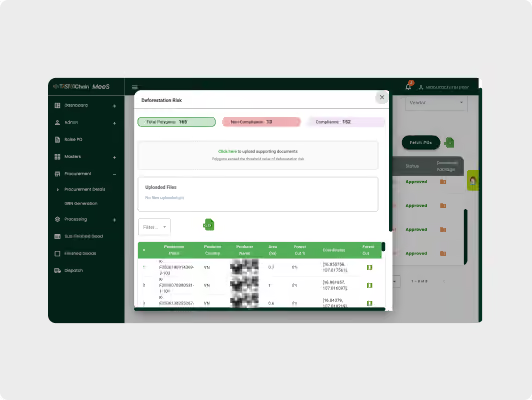
Every GeoJSON and DDS is validated automatically for each shipment before you file.
TRST01 interface graphic
A supplier portal with automated notifications means follow-ups happen on their own, so you never miss a pending item.
TRST01 interface graphic
One central repository of all documentation, transaction history and linked DDS, audit-ready at any moment.
TRST01 interface graphic
Direct API integration files the DDS in one click, with no double entry.
TRST01 interface graphic
One dashboard shows live status of every supplier, what data is received and what is pending.
Manual: email, Drive, Excel
Ad-hoc screening, missing documents, no expert review.
Manual checks that let errors slip through, leading to EU TRACES NT rejections.
Repeated emails and calls to chase data, and items that fall through the cracks.
Records scattered across inboxes, drives and sheets, a scramble every time an audit lands.
Manual re-keying into EU TRACES NT, duplicated effort and transcription mistakes.
Chase different people for hours just to learn where anything stands.
Why MeeS
How MeeS streamlines your EUDR workflow
The same compliance, done in a fraction of the time, with the risk of a rejected submission designed out.
TRST01 interface graphic
 how it works
From vendor onboarding to a filed declaration
Four steps that fit your procurement and production. Tap a step to explore it.
TRST01 chart interface
The platform
Every EUDR job, in four connected modules
TRST01 interface image
Vendor Management
Centralize vendor compliance: profiles, documents, polygons and DDS, with renewal alerts.
TRST01 interface image
Procurement
A validation gate at intake: PO-linked polygon and DDS uploads, auto-checked before approval.
TRST01 interface image
Manufacturing & traceability
Automatic finished-goods traceability: QR batch tracking and input-to-FG linkage, no mass balance.
TRST01 interface image
Customer portal
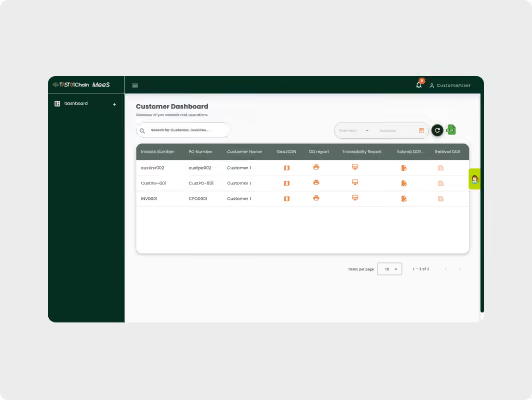
Deliver the proof: consolidated DDS, certificate and GeoJSON, via portal or EU TRACES NT.
Integration-ready with your ERP
Before you place a covered product on the EU market, you must prove four things, and file the proof to EU TRACES NT.
01
GeoJSON sanity
Format checked to EU TRACES NT standards, plus overlaps, minimum points and land presence, so no ocean or mis-mapped plots slip through.
02
Forest-cut analysis
Polygons cross-checked against WDPA, DOPA and Global Forest Watch, with deforestation since 2020 detected by our ML model on Sentinel-2 data.
03
Yield test
Declared quantity compared against plot yield, with regional caps to catch abnormal declarations, tracked in a central repository.
04
Ring fencing
A vendor's whole plot base is risk-vetted once on legal, social and environmental risk, so future POs only ever use approved plots.
Who uses it
Three portals, one connected chain
Feature icon
Manufacturer / Processor
Runs the MeeS portal: onboards vendors, raises POs, reviews compliance, and issues the consolidated DDS.
Feature icon
Vendors & suppliers
Use the vendor portal to complete profiles and upload polygons and DDS against each PO, and see analysis results.
Feature icon
Your EU customers
Use the customer portal to pull the consolidated DDS, certificate and GeoJSON for every shipment.
Source directly from farmers too?
See TRST01Chain for upstream sourcing →
Proof & resources
See it in the field, and get ready yourself
customer story
How Ascenso Tyres made every EU shipment DDS-ready with TRST01Chain MeeS
Read Full Story →
customer story
How JK Tyres brought multi-country supplier compliance into one EUDR workflow
Read Full Story →
customer story
How CEAT Tyres made EUDR run inside its existing systems with MeeS
Read Full Story →
customer story
How Tower Commodities went from scattered supplier data to audit-ready EUDR compliance
Read Full Story →
customer story
How SLN Coffee got its green coffee EUDR-ready with TRST01Chain
Read Full Story →
customer story
How Gadjahruku brought end-to-end transparency to a complex rubber supply chain
Read Full Story →
FAQ
MeeS & EUDR FAQ
We buy from vendors and traders, not farms. How do we align to comply with EUDR?

EUDR follows the commodity through the whole chain, so if your finished goods contain a regulated commodity they must be deforestation-free, legal and traceable to the plot, whether you place them on the EU market or supply a buyer who does. Your vendors provide the evidence for what they sell you; you hold it and stand behind it. MeeS collects, validates and consolidates that evidence so your finished product stays compliant.

Do we need polygons from our vendors, or are coordinates enough?

For production areas above the size threshold (generally plots over 4 hectares) a polygon tracing the boundary is expected, not just a point. Vendors supply the plot geometry as a GeoJSON file, which MeeS validates on upload, so you are checking that vendor polygons meet the standard rather than mapping any plots yourself.

How does the purchase-order flow work?

In the Procurement module you raise a PO, from your ERP or manually, and the vendor is notified. They upload the polygon and DDS for that consignment, MeeS runs automatic validation, and you approve or request corrections. A Goods Receipt Note (GRN) is generated on shipment, so evidence is tied to each specific consignment.

What is ring fencing?

Ring fencing means onboarding a vendor's full plot base and risk-vetting it once, on legal, social and environmental risk, so only pre-approved plots can be used on future purchase orders. It cuts repeat checking and keeps unvetted land out of your chain.

How does MeeS stop a non-compliant plot reaching a shipment?

Every vendor upload passes four automatic checks: GeoJSON sanity, forest-cut analysis (against WDPA, DOPA and Global Forest Watch on Sentinel-2 data), a yield test, and ring fencing. Anything that fails is flagged and kept out of the consignment before goods are received or production starts, and you approve or reject with the results in front of you.

How is deforestation analysis run on vendor-supplied polygons?

When a vendor uploads a polygon, MeeS assesses that plot against the 31 December 2020 baseline using the EU-referenced layer plus supporting layers, with deforestation detected by an ML model on Sentinel-2 satellite data. It returns a plot-level compliant or at-risk verdict that feeds your approval decision. MeeS never maps farms; it validates the plots your vendors supply.

How do you keep compliant and non-compliant material apart in our plant?

The Manufacturing module enforces batch-level segregation with QR-code tracking from intake to finished product, so lots stay identifiable rather than blended. EUDR does not allow mass-balance mixing, and this segregation is how MeeS honours it: only accepted, validated inputs flow into an EU-bound batch.

How do you build one DDS from many suppliers?

When a finished product draws on several vendors and origins, MeeS merges the plot geometry into a consolidated GeoJSON and generates a single Due Diligence Statement for the finished product, built from the validated vendor evidence and the input-to-output mapping. It is delivered via the customer portal or pushed to EU TRACES NT by API.

Do we have to integrate our ERP to use MeeS?

No. Integration with SAP, Oracle, NetSuite, Tally and others is available via API so PO, GRN and invoice data flow with no double entry, but it is optional. You can also capture production data by FTP or Excel upload, and add integration later.

Can we try MeeS before committing?

Yes. The free EUDR Polygon Checker lets you validate a supplier's GeoJSON and screen deforestation risk with no commitment, a simple way to test vendor data you already hold. From there, the full platform adds vendor management, the validation gate, internal traceability and consolidated documents.